
Governors ranking: Morena widens its lead and strengthens its territorial position
Claudia Sheinbaum’s approval rises, eight of the ten best-rated governors are from Morena, and the party leads the legislative scenario in 31 of 32 states. Security, drug trafficking and corruption remain the public’s main demands.
8,636 completed interviews · 32 states · Margin of error ±1.34% · Fieldwork September 18–23, 2026.
Download the full survey here and see all the results of the September 2026 Ranking Rubikon México (in Spanish).
The September Ranking Rubikon México, the second edition of the study, shows a more defined political picture than the one observed a month earlier. The ruling party improves on several indicators at once: presidential approval grows, Morena increases its party identification, widens its share in the electoral scenarios and keeps a dominant presence among the best-rated governors. The trend is therefore not concentrated in a single figure or question; it appears across different levels of the measurement.
That strengthening, however, coexists with a Mexican public that identifies precisely where its main demands lie. Insecurity and drug trafficking again top the public agenda, while fighting corruption remains the area of federal management with the worst balance. September portrays an electorate that can stand politically with the government and, at the same time, keep a critical view of specific problems it considers unresolved. That coexistence of support and demand is probably the main key to interpreting the month.
Security: the main problem and the biggest improvement of the month
22.6% of Mexicans identify insecurity and violence as the country’s main problem; another 19.8% point to drug trafficking and organized crime. Together, 42.4% rank these problems above any other concern. Corruption comes next at 19.2%, followed by the economic situation and the cost of living at 11.6%, and lack of jobs and low incomes at 10.2%.
Security also shows the biggest gain in the rating of federal management: its balance improves by 5.2 points compared with August, moving from −13.8 to −8.6. The movement is favourable, although the rating remains negative. Perception is improving, but the issue remains at the centre of public demand.
Sheinbaum: support grows and the wallet follows
Claudia Sheinbaum’s approval rises from 52.4% in August to 55.3% in September, an increase of 2.9 percentage points. With disapproval at 40.1%, her net balance reaches +15.2 points. The measurement shows a broadening of presidential support over the period observed.
Perceptions of personal finances offer a complementary reading. 58% say they are just as well off or better off than a year ago, compared with 39% who say they are just as badly off or worse. These proportions are close to those of presidential approval and disapproval. That overlap helps interpret the mood of the month, although it does not allow support for the government to be attributed to the wallet alone.
Social programs hold up; corruption remains unresolved
Social programs are the main asset of the federal administration: they receive 71.5% positive ratings against 25.7% negative, a balance of +45.8 points. The gap with the other areas shows how much weight social policy still carries in the public’s assessment.
Economy and jobs reach a slightly positive balance of +0.5, and relations with the United States register +5.5. By contrast, security and crime stay at −8.6, and fighting corruption shows −26.8, the most negative balance of the six areas rated.
Five of the six areas improve compared with August. Overall political support and the assessment of specific problems, however, move on different planes: a public that approves of the president can remain critical on security or corruption.
Morena concentrates party identification, with a large undefined segment
Morena reaches 41.0% party identification, almost four times the PAN’s 10.3%. Movimiento Ciudadano registers 9.0% and the PRI 7.0%. Adding the PT and PVEM, identification with the parties of the ruling bloc totals 43.3%.
The other relevant figure is the 29.1% who do not report a specific identification: 18.6% do not identify with any party and 10.5% answer that they do not know. This segment exceeds the 26.3% that the PAN, MC and PRI gather combined. Its size matters for the next electoral cycle, although the absence of identification does not automatically mean availability for an opposition party.
Rejection adds another dimension. The PRI has the highest share of people who say they would never vote for it, at 47.5%, followed by the PAN at 33.3% and Morena at 29.9%. MC has the lowest rejection, at 15.9%. Identification and rejection together distinguish each party’s current base from the limits it faces in order to grow.
Chamber of Deputies 2027: ruling-party advantage and significant indecision
Morena leads voting intention for the Chamber of Deputies with 39.6%. The PAN and Movimiento Ciudadano are practically tied, at 11.2% and 11.1% respectively; the PRI reaches 8.1%. 13.1% still do not know whom they would vote for, a larger share than any party other than Morena.
Morena, PT and PVEM together reach 43.0%, against 30.4% for the PAN, PRI and MC combined, a gap of 12.6 points. This is an arithmetic comparison between political forces; it does not imply an alliance among the opposition parties.
Besides the undecided, 6.3% say they would spoil their ballot or vote blank and 6.2% say they would not go to vote. Stated willingness to participate is high: 56.2% say they will definitely vote and 27.0% that they probably will. This intention describes the moment of the survey and is not an estimate of actual turnout.
The governors: the Morena brand and differences in performance
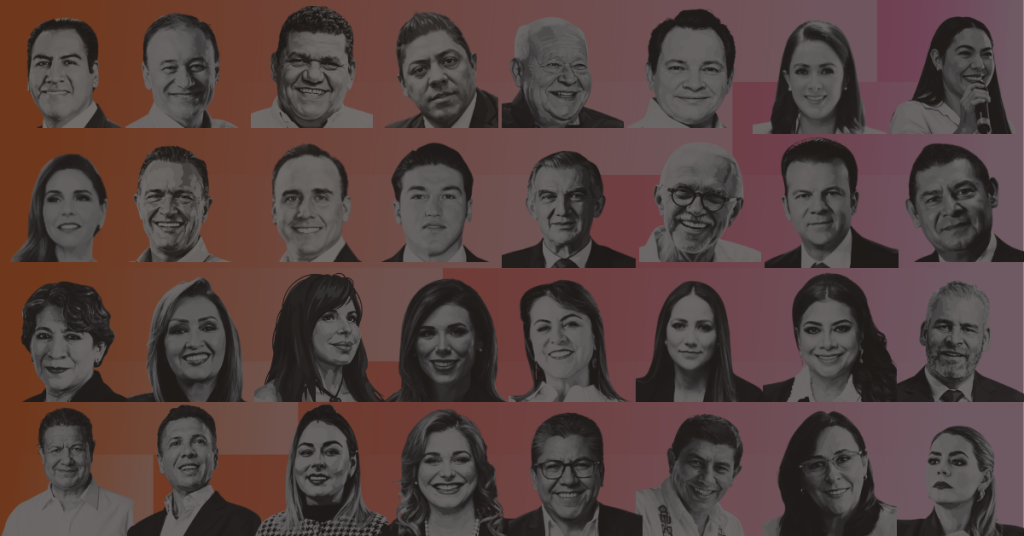
Eduardo Ramírez Aguilar, of Chiapas, keeps first place in the ranking with 65.5% approval. He is followed by Alfonso Durazo, of Sonora, with 63.0%, and Javier May, of Tabasco, with 61.7%. All three belong to Morena, which holds the top six places and eight of the ten highest-approval positions.
The Top 10 also includes Clara Brugada, Miguel Ángel Navarro, Delfina Gómez, Américo Villarreal and Alfredo Ramírez Bedolla. Mauricio Kuri, of the PAN, is seventh and Manolo Jiménez, of the PRI, tenth.
The stability of the top three contrasts with movement across the rest of the table: 11 governors move up, 16 move down and five stay in the same place. Tamaulipas climbs 12 positions and Clara Brugada rises four. Baja California Sur and Yucatán register approval drops of more than nine points; Zacatecas closes the ranking.
The party’s territorial strength can also be seen in the legislative election: Morena leads voting intention in 31 of the 32 states, even where its governors receive less favourable ratings. Querétaro is the exception. Support for the party brand extends beyond the differences between its administrations.
The comparison with Sheinbaum requires looking at each state separately, rather than contrasting state percentages with her national approval. In that breakdown, the president outscores the governor in 31 states. Querétaro is again the exception.
Harfuch widens his lead on the road to 2030
Omar García Harfuch reaches 34.2% of prompted preference among Morena’s possible hopefuls, against 8.1% for Marcelo Ebrard and 7.7% for Clara Brugada. Harfuch increases his share compared with August, while Ebrard loses 3.3 points and Brugada sits less than one point from second place.
His position is reinforced by his image: he records 62.8% positive and 20.5% negative ratings, a balance of +42.3 points, the highest among the national figures measured. His lead among ruling-party hopefuls thus coincides with a broadly favourable personal rating.
That a figure associated with security stands out when that issue concentrates public demand is a relevant element to follow. The survey does not allow a causal relationship to be established between the two. Nor does it close the internal race: 22.1% would choose none of the names offered, 12.3% still do not know and 13.9% select another hopeful.
The opposition: strong figures and parties with different challenges
Jorge Álvarez Máynez, with 21.2%, and Luis Donaldo Colosio, with 14.0%, lead preferences among the opposition hopefuls included. Both belong to Movimiento Ciudadano. They are followed by Ricardo Anaya, with 10.2%; Ricardo Salinas Pliego, with 9.6%; Xóchitl Gálvez, with 5.8%; and Alejandro Moreno, with 3.0%.
MC combines well-positioned figures with the lowest party rejection, but that strength still coexists with an identification of 9.0%. The PAN keeps the second-highest individual identification, although it faces 33.3% rejection. The PRI has a smaller base and the highest rejection. The challenges of broadening the electorate are different for each party.
In the hypothetical presidential scenario, Morena and allies reach 43.4%, against 17.8% for a PAN-PRI option and 14.5% for MC. Even combined, the two opposition options gather 32.3%, below the ruling party. That sum helps size the current gap, without anticipating how the electorate would behave in the face of a possible joint candidacy.
What September leaves us
One figure keeps recurring in the ruling party’s position: 43.3% party identification, 43.0% legislative voting intention and 43.4% in the 2030 presidential scenario. The closeness between indicators shows consistency in current support. Because these are different questions, it is not a guaranteed electoral floor.
The advantage is broad and territorially widespread. How it evolves will remain tied to a public that keeps concrete demands: security is improving without ceasing to be the main concern, social programs keep a very favourable rating, and corruption remains the biggest unresolved issue.
The Ranking Rubikon will keep watching how political support, the assessment of government performance and electoral preferences relate to one another. At this distance from 2027 and 2030, the measurements make it possible to follow trends and areas of competition. Their value lies in watching the film that the months build.
METHODOLOGY
National survey of voting-age residents of Mexico. 8,636 completed interviews, conducted between September 18 and 23, 2026, covering all 32 states. Reported margin of error for the total national sample: ±1.34%, at a 95% confidence level.
Fieldwork was carried out continuously using stratified random online sampling. The sample was built through a certified professional online panel, combined with targeted recruitment on social media and quality filters for geography, age, education and recent political participation. The questionnaire was self-administered and optimized for mobile phones and computers, with an average completion time of eight minutes.