
Brazil 2026: the election poll that called Lula’s re-election
On the night of October 24, hours before the polls opened, Rubikon Intel published its national Brazil election poll for the presidential runoff: Lula 50.9%, Flávio Bolsonaro 49.1%. The next day, the Superior Electoral Court confirmed Lula’s re-election with 51.79% against 48.21%. While the country’s leading pollsters had Flávio winning, our study pointed to the right winner, 0.9 points from the result.
1,592 valid responses · National coverage · Margin of error ±2.5% · Fieldwork October 23–24, 2026.
🇧🇷 Brasil 2026 | Empate técnico
— Rubikon Intel (@RubikonIntel) October 24, 2026
Lula: 50,9%
Flávio Bolsonaro: 49,1%
La diferencia de 1,8 puntos está dentro del margen de error teórico del estudio nacional de Rubikon Intel.
📅 24 de octubre de 2026
Base: 1.592 respuestas válidas.
#Brasil2026 #RubikonIntel
Rubikon Intel’s original post on X, October 24, 2026.
We published it as a statistical tie, and it was: the gap was within the margin of error. But the direction mattered, and we had it right. Of the 21 national Brazil election polls released in the final stretch, 18 had Flávio winning and all 21 underestimated Lula’s vote, according to a review by Rede98.
It was not luck. Our data show where the vote was that much of the market missed.
How we compared
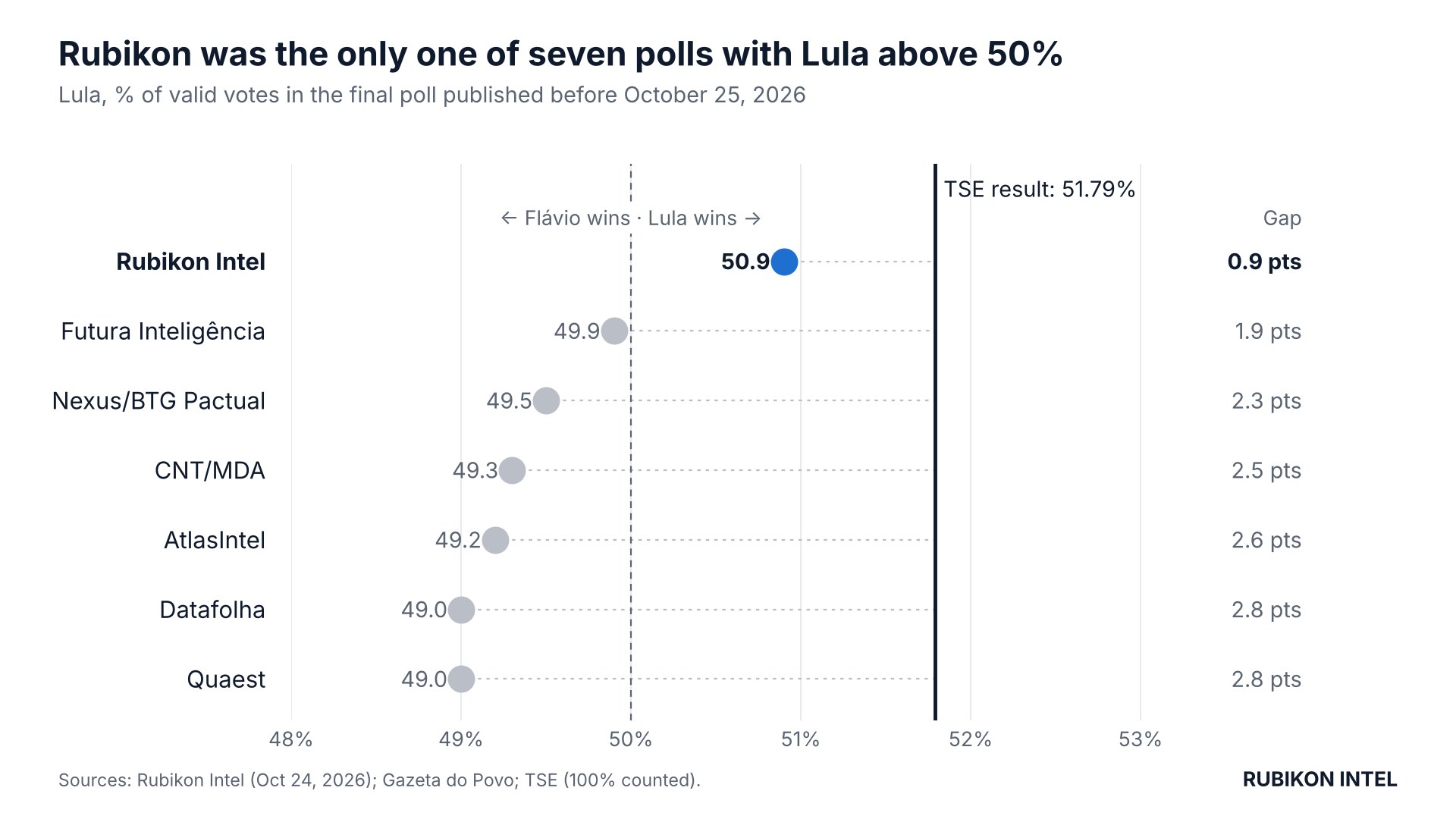
Datafolha and Quaest closed with Flávio ahead 51% to 49%. AtlasIntel, with nearly 5,000 interviews and a stated one-point margin, had Flávio at 50.8% to 49.2% and ended 2.6 points from the result. Futura, named by the Brazilian press as the closest, was 1.9 points off (Gazeta do Povo). Rubikon Intel was 0.9 points off, and the only one of the seven with Lula above 50%.
The voter no one counted was Lula’s
Among Lula’s voters, 12.3% said they would never vote if voting were not mandatory. Among Flávio’s, only 5.1%. In addition, 19.9% of Lula’s runoff voters had not voted in the first round, compared with 13.9% of Flávio’s.
A strict “likely voter” screen cuts more from Lula than from Flávio. That is the explanation now circulating in Brazil: Datafolha found Flávio ahead among high-propensity voters and Lula ahead among medium- and low-propensity ones (Blog do Esmael). Those voters turned out, and they decided the election.
Timing mattered too. Our fieldwork ran on October 23 and 24, hours before the vote, and captured the final movement toward Lula.
An election split by age
Lula led in every age group under 55: by 21.6 points among 16-to-24-year-olds and by 19.4 among those aged 35 to 44. Flávio dominated among older voters: a 22.5-point lead among those aged 55 to 64, and 41.7 points among those over 65.
Margins of error by group are wider than for the total, so these figures should be read as a trend. But the pattern is clear: Lula’s re-election rested on young and middle-aged voters.
Bolsa Família and the Northeast, Lula’s firewall
In households receiving Bolsa Família, voting intention stood at 64.6% for Lula and 26.5% for Flávio. In the Northeast, 55.3% to 32.3%. The official result confirmed it: the Northeast gave Lula a net margin of 13.7 million votes (Bloomberg Línea).
Flávio won the agenda; Lula won the vote
Flávio was seen as the better candidate on security (47.5% to 33.6%), fighting corruption (42.6% to 33.8%) and relations with the United States (48.2% to 33.7%). Lula led clearly only on social programs (47.3% to 34.0%), and the two were practically tied on the cost of living.
Owning the issues was not enough to win. For a decisive part of the electorate, what counted was what they experience directly at home.
The mood expected Flávio
46.1% of respondents expected Flávio to win, and only 38.9% expected Lula to. His voters were also more confident: 92.3% of Flávio’s voters expected him to win, compared with 82.5% of Lula’s.
The sense of victory did not match voting intention. When the mood and the data part ways, follow the data.
Brazil 2026: measuring well means deciding who counts
In an election with compulsory voting, the citizen who says they would not vote by choice still decides. Screening them out aggressively produces an electorate that is older, more southern and southeastern, and more favorable to Flávio than the one that actually voted.
Sample size is no substitute for method. Brazil’s election was not decided by the mood or the agenda, but by who turned out. Understanding that voter, not just their preference, is what we do in Mexico, Colombia, Argentina, Peru and the U.S. Latino market.
METHODOLOGY
Rubikon Intel’s national study of Brazil’s 2026 presidential runoff was conducted among voters nationwide.
It comprises 1,592 valid responses collected on October 23 and 24, 2026. The theoretical margin of error for the total sample is ±2.5%, at a 95% confidence level. Results were published on October 24, 2026.
The questionnaire was online and self-administered (CAWI), using professional online panels. Results were weighted by sex, age, region, municipality type, education and first-round vote recall. Voting intention is reported as a share of valid votes.