
Governors ranking: Morena leads and holds its advantage on the road to 2030
Sheinbaum’s approval remains in positive territory, while security and corruption concentrate public discontent; Harfuch leads the ruling-party succession and Movimiento Ciudadano advances within the opposition.
7,786 completed interviews · 32 states · Margin of error ±1.39% · Fieldwork August 10–15, 2026.
Download the full survey and see all the results of the August 2026 Ranking Rubikon México (in Spanish).
At the start of Claudia Sheinbaum’s second year in office, the August 2026 Ranking Rubikon México offers a sharp reading of the national mood. With 7,786 cases covering all 32 states, the study cross-references governor approval, federal approval, party identification, willingness to vote in 2027 and the 2030 presidential scenario. The picture that emerges is not one of a country divided over its direction, but of one that largely stands with the ruling party while also making demands of it. Morena holds a clear lead, and the same citizens who back it have a to-do list they can name with precision.
What worries the country
Before looking at the political players, it is worth looking at the citizens. Asked about the main problem facing Mexico, 40.8% point to security or organized crime (21.4% insecurity and violence, 19.4% drug trafficking and organized crime). Add corruption (19.2%), and almost six in ten Mexicans rank insecurity or corruption above any other concern. The economy comes next: cost of living (14.1%), jobs and income (10.6%), health (6.8%).
That order of priorities coexists with household finances that are tight but perceived to be improving. Three out of four households (74.6%) say they live without savings or struggle to cover expenses; yet the balance compared with the previous year is clearly positive: 45.4% say they are better off than twelve months ago and 28.4% worse off, a net balance of +17 points. This helps explain why the wallet is not where approval of the government is being decided today: most people are stretched, but they see themselves on an upward path. Public demand lies elsewhere.
The governors: a ruling-party advantage, judged by the same yardstick
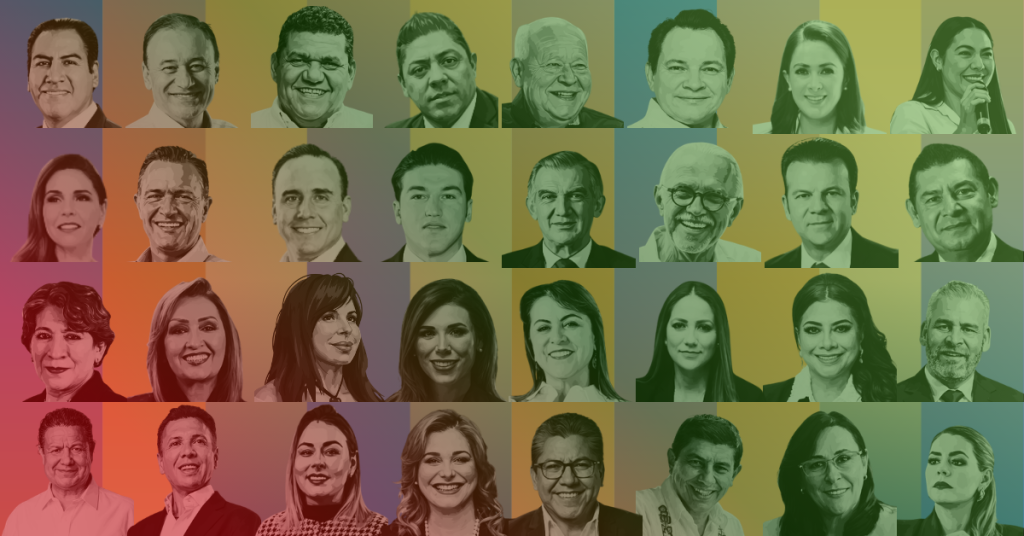
The ranking of the 32 governors orders the country by approval, and at the top is Eduardo Ramírez Aguilar (Chiapas), with 68.4%, the highest rating in the Republic. He is followed in the outstanding zone by Alfonso Durazo (Sonora, 64.3%), Javier May (Tabasco, 63.3%), Víctor Manuel Castro (Baja California Sur, 62.2%) and Joaquín Díaz Mena (Yucatán, 61.6%). It is an entirely Morena lead group, and what they share is an administration strongly anchored in social programs and visible public works.
The full picture, however, rules out any one-colour reading. The vast majority of the country’s governors, from every party, sit in positive territory, above the 50% threshold. And that group is not exclusive to the ruling party: in the upper band, Morena governors share space with opposition governors who govern well. Manolo Jiménez (PRI, Coahuila) reaches 57.3% and Samuel García (MC, Nuevo León) 54.7%, both in the Top 10 and ahead of several ruling-party governors. Performance, more than party colour, is what sustains approval.
The middle of the table includes recent ruling-party administrations (Delfina Gómez in the State of Mexico at 48.4%, Marina del Pilar Ávila in Baja California at 47.5%), a sign that the map has light and shade even within the governing bloc itself. At the bottom, David Monreal (Zacatecas) closes the ranking with 33.2%, the only state in the critically low zone and a notable exception in a landscape that, overall, favours incumbent governors.
Sheinbaum: majority support in her second year
The president reaches August with solid approval: 52.4% approve of her performance versus 42.6% who disapprove, a net balance of +9.8 points. It is a clear majority, sustained by a core that approves with conviction (23.8% “a lot”, 28.6% “somewhat”) against a firm but minority opposition bloc. In her second year in office, and in a country whose main concern is security, retaining majority support of this size is the most politically significant finding of the study.
The study also measures, separately, support for the Fourth Transformation brand as a project, and there the numbers even out (34.4% approve, 33.9% disapprove, with a third placing themselves in neither camp). This distinction should be read carefully: evaluating a political label in the abstract tends to polarize more than evaluating a person or a concrete administration. Support for Sheinbaum as head of government is a majority and does not depend on the ideological temperature the project’s label generates. The president carries weight in her own right.
What sustains the federal government, and what is demanded of it
The quantitative rating of the federal government averages 5.49 on a scale of 1 to 10. The average, however, hides more than it shows: the distribution is bimodal, with 42.4% of the country rating it in the high range (7 to 10) and a floor of harsh criticism at the opposite end. The key to understanding that polarization lies in the ratings by policy area.
The government’s great asset is its social programs: a net balance of +43.6 points, with seven in ten Mexicans approving of them. This is the pillar on which the ruling party’s rating rests and the most direct explanation for the support the president retains. At the other extreme, fighting corruption (−30.0) and security (−13.8) are the fronts where perception turns negative. The overlap is no coincidence: these are exactly the two issues citizens named as the country’s main problem.
This is a reading about the agenda, not a crisis. The federal government has a majority mandate and a dominant asset in social policy, and it faces a task that its own voters point to clearly. This is not a government losing support; it is one with broad backing and a clearly identified pending demand. That, not household finances, is where its room to grow is being decided today.
Harfuch, the ruling party’s biggest political asset
Looking ahead to the 2030 succession, the ruling bloc has an undisputed front-runner. Omar García Harfuch takes 30.4% of preferences among Morena hopefuls, almost three times Marcelo Ebrard, his closest rival at 11.4%. The rest of the field (Fernández Noroña, Brugada, Monreal, Adán Augusto López) trails far behind.
The figure that redefines his position is not his share of preferences but his image. Harfuch has the best net image balance of all the national figures measured: +38.6, with 60.6% positive opinion and just 22.0% negative. He ranks above President Sheinbaum herself (+16.9), Jorge Álvarez Máynez (+17.1) and Luis Donaldo Colosio (+13.7). And here a question arises that the study leaves open and that is worth following: the fact that the person responsible for security policy has the strongest image in the country, precisely when security is the public’s main grievance, is a political fact in its own right. How that tension is resolved, between the circumstances that put him at the centre and the personal capital he has built, will be one of the keys of this cycle.
There is also room still open. The 26.2% who answer “none” and the 13.1% who are still undecided add up to nearly four in ten respondents without a defined ruling-party candidate. Harfuch’s lead is large, but the internal race is far from settled.
The opposition realigns toward Movimiento Ciudadano
On the opposition side, the most significant movement is structural. The two best-positioned hopefuls belong to Movimiento Ciudadano: Jorge Álvarez Máynez (18.6%) and Luis Donaldo Colosio (15.5%), who together add up to 34.1%, more than all the figures of the traditional opposition combined, with Ricardo Salinas Pliego (10.0%), Ricardo Anaya (8.9%), Xóchitl Gálvez (7.1%) and Alejandro Moreno (3.3%) sharing the rest.
The bloc scenario confirms the trend: in a hypothetical presidential vote, Movimiento Ciudadano reaches 16.4%, just 1.8 points behind the PAN-PRI opposition (18.2%). And image goes hand in hand: Máynez, with a net balance of +17.1, ranks ahead of several leading national figures, while Alejandro Moreno has the worst image in the study (−28.4). The opposition space can no longer be read only in PAN-PRI terms; Movimiento Ciudadano occupies the place of the forward-looking opposition, while the traditional axis carries the accumulated wear and tear.
It is important, however, to keep things in proportion. This realignment is happening within the opposition camp. In the same bloc scenario, Morena and its allies obtain 38.4%, more than double any single opposition force. Party identification says the same: Morena gathers 38.6%, four times the second place. What is moving is the composition of the opposition, not the ruling party’s dominant position.
What comes next
The August portrait is consistent in its main stroke: Morena is winning and keeping majority ground in presidential approval, in the ratings of most of its governors, in party identification and in the 2030 scenario. On top of that underlying fact sit the nuances that give texture to the political moment.
The first is the agenda that the electorate itself sets for the government: security and the fight against corruption, the two fronts where perception is negative and, not by chance, the ground on which a good part of Harfuch’s race will be played. The second is the opposition’s realignment around Movimiento Ciudadano, whose consolidation will depend on whether it can become a party phenomenon or remains anchored to the individual strength of its two figures. Neither changes, for now, the arithmetic of the majority; both define the climate in which that majority will be exercised.
The Ranking Rubikon will keep taking the pulse month by month. At this distance from 2027 and 2030, the snapshot matters less than the film: what is decisive is not where each player stands today, but where they are heading.
METHODOLOGY
National survey. 7,786 completed interviews conducted between August 10 and 15, 2026. Coverage: 32 states. Margin of error: ±1.39% at 95% confidence. Stratified random online sampling, combining a certified professional online panel with targeted recruitment through social media and quality filters (geography, age, education, recent political participation). Self-administered online questionnaire, optimized for mobile phones and computers. Average completion time: 8 minutes.