
Ranking Rubikon México: stability at the top, movement in the states
Claudia Sheinbaum reaches her best approval balance across the three waves, the governors’ podium remains unchanged and Morena keeps a broad lead on the road to 2027. At the same time, October shows that the biggest political shifts are happening in the states, with Jalisco as the month’s most visible case.
9,022 completed interviews · 32 states · Margin of error ±1.26% · Fieldwork October 21–26, 2026.Download the full survey here and see all the results of the October 2026 Ranking Rubikon México (in Spanish).
A single survey offers a snapshot. Three consecutive waves, conducted with the same methodology, begin to show a film in progress.
The October edition of the Ranking Rubikon México makes it possible to follow a full three-month sequence —August, September and October— covering the 32 state governments, presidential approval, the public’s main concerns and the scenarios on the road to 2027. That continuity helps separate short-term movements from more persistent trends.
October’s main takeaway is twofold. At the top of the political system there is considerable stability: Claudia Sheinbaum improves her approval once again, the three best-rated governors hold their positions and Morena maintains a broad national lead. But beneath that stability there is a great deal of movement. Public concerns are shifting, local evaluations diverge from state to state and the electoral outlook shows that 2027 cannot be read as a single national scenario.
Mexican politics keeps relatively stable structures at the top, but it is increasingly explained from the ground up, state by state.
Security still tops the list of concerns, but corruption and health gain ground
Security remains the main problem cited by Mexicans. Adding insecurity and violence to drug trafficking and organized crime, 38.1% name one of these issues as the country’s main concern.
However, its weight falls 4.3 points from September. The change does not knock security out of first place, but it does open space for other issues on the public agenda. Corruption reaches 19.7% and becomes the second most-mentioned individual problem, while health and access to medicines posts the largest monthly increase.
The combination matters because it shows a public agenda that is starting to diversify. Security remains a structural concern, but corruption and health are beginning to compete more strongly for public attention, and they call on the country’s authorities to focus on them.
This shift is consistent with the specific evaluations of the federal government. Security and crime is the only one of the six areas measured that improves its balance in October, although it remains in negative territory. Health, by contrast, shows the sharpest deterioration of the month, while the fight against corruption remains the area with the worst balance.
Public opinion appears to distinguish quite precisely between the different components of the administration’s performance, rather than judging them as a single block.
A resilient economy
Households’ economic perception remains stable, though with some warning signs.
41.4% say they manage to cover their expenses but without saving, while 32.9% say they can get by and put some money aside. At the most vulnerable end, 19.4% have difficulty covering their expenses.
When comparing their current situation with a year ago, 24.5% say they are better off and 20.3% worse off. The balance remains positive, but it narrows from September.
Rather than a crisis scenario, the data describe a household economy of endurance: a majority manages to get by, although for a considerable share of households the available margin remains thin. That balance will be especially relevant as the 2027 electoral cycle approaches.
Sheinbaum reaches the best balance of the series
One of the most consistent movements across the three waves is seen in President Claudia Sheinbaum’s approval.
The President reaches 55.8% approval in October, against 39.8% disapproval. It is her second consecutive improvement: in August she stood at 52.4% and in September at 55.3%.
The movement is even clearer when looking at the net balance, that is, the difference between approval and disapproval. It goes from +9.8 points in August to +15.2 in September and +15.9 in October, the highest level of the series.
Added to this is the perception of the country’s overall direction. 52.3% believe Mexico is on the right track, compared with 42.6% who think otherwise.
The public rates Sheinbaum more favorably than several areas of her administration. Social programs remain the government’s main asset, with a balance of +40.9 points, but five of the six areas measured worsen from the previous month. Health shows the largest decline and corruption remains the main liability.
Presidential approval, therefore, should not be confused with a uniform evaluation of the entire administration. The data show a President with her own political capital, alongside a public that maintains concrete demands on services, health, corruption and the economy.
Social programs remain the main pillar of support
In the federal evaluation, social programs hold a very different position from the rest of the areas. Almost seven in ten Mexicans rate them positively, and their net balance remains well above any other component of the administration. In addition, 41.6% of households surveyed in the relevant subsample report that at least one person at home receives a federal social program.
The importance of this indicator goes beyond the approval figure. Social programs represent a dimension of public policy that a significant part of the population experiences directly in everyday life.
This helps explain why critical evaluations in specific areas can coexist with strong majority approval of the President. The public is not issuing a single verdict on the government: it distinguishes between specific policies, sectoral results and political leadership.
Three months and the podium remains intact
In the governors ranking, October once again shows remarkable stability at the top.
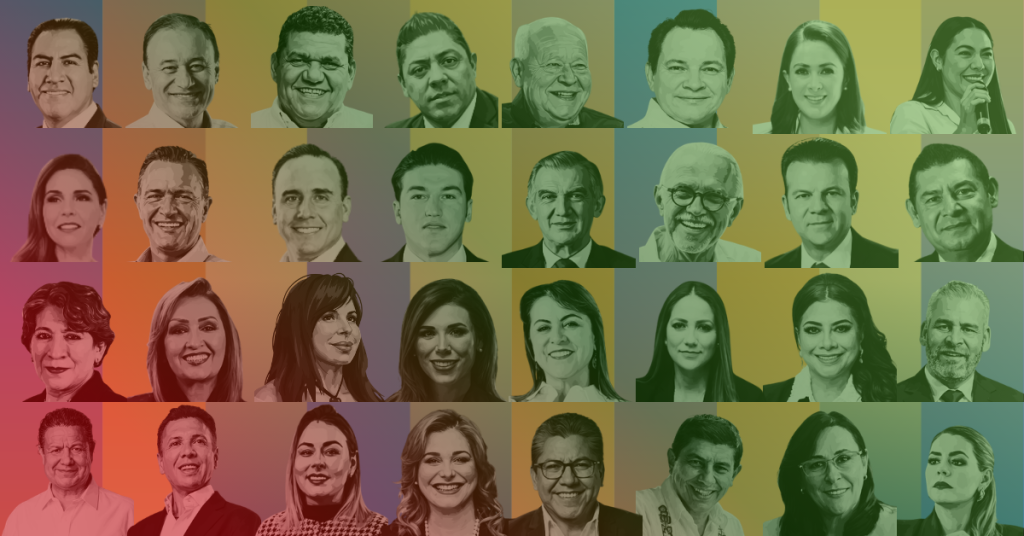
For the third consecutive month, Eduardo Ramírez Aguilar of Chiapas ranks first with 64.8% approval; Alfonso Durazo of Sonora remains second with 62.7%; and Javier May of Tabasco is third with 60.2%.
They are the only three governors above 60%, and they also remain in the outstanding evaluation category.
This continuity is particularly relevant because it is not based on a single measurement. Chiapas, Sonora and Tabasco have held the same positions across all three waves of the Ranking Rubikon. The figures show small monthly variations, but none of the three loses its place on the podium.
Below them, however, the picture is much more dynamic. Fourteen governors improve their position, fourteen fall back and four stay the same. Mara Lezama in Quintana Roo and Evelyn Salgado in Guerrero post some of the biggest improvements and enter the Top 10. Joaquín Díaz Mena in Yucatán and Samuel García in Nuevo León also join the group of the ten best-rated governors.
The contrast within Movimiento Ciudadano itself illustrates how much state dynamics matter: while Samuel García improves and enters the Top 10, Pablo Lemus in Jalisco records the steepest drop in the entire ranking.
There is, therefore, no uniform movement by party. October shows that governors’ evaluations increasingly respond to what happens within each state.
Jalisco: from a service crisis to a crisis of trust
Jalisco accounts for the month’s strongest political movement. Pablo Lemus falls nine points from September, to 36.3% approval. It is the largest drop among the 32 governors and coincides with a situation marked by the water crisis in the Guadalajara metropolitan area and the citizen mobilizations that took place during October.
To look more closely at this dynamic, Rubikon conducted a specific survey in the state. The results show that the issue reached an unusual level of awareness and mobilization: 91.4% of Jalisco residents had seen or heard about the protests, and around 92% said they agreed with them.
The evaluation of the state government’s handling of water is especially negative. Roughly 72% rate it poor or very poor, and 41.6% choose “very poor” outright.
The impact also goes beyond the governor. Half of the Jalisco residents surveyed say their opinion of Movimiento Ciudadano worsened as a result of the crisis. Among those who have ever voted for the party, only 32% say they would do so again. This means that nearly two in three respondents who voted for Movimiento Ciudadano would not do so again.
The figure should be read with caution, as with any measure of stated behavior. But the convergence of the governor’s declining rating, the rejection of the water management and the loss of trust in MC makes Jalisco one of the most important states to follow in the coming waves.
The crisis also reveals a telling paradox about responsibility and expectations. 46.5% mainly blame the state government, while just 8.7% place the responsibility on the federal government. Yet when asked who is best placed to solve the problem, 45.3% point to the federal government.
Responsibility is seen as mainly local, but a significant share of the expectation for a solution is directed at the federal government. This shows how a public service problem can stop being a purely administrative matter and become a question of political trust.
Morena keeps a broad lead, and three in ten Mexicans have no party
In the national party landscape, Morena retains a dominant position. 40.1% of Mexicans say they identify with Morena. The PAN is second with 10.8%, followed by Movimiento Ciudadano with 8.0% and the PRI with 7.5%.
The gap is considerable, but the most important figure outside Morena remains the size of the electorate with no defined party identity. Adding those who say they do not identify with any party and those who do not yet know, 29.3% of Mexicans remain without a party anchor.
That is a far larger group than the individual base of any opposition party. This segment will be central to understanding how much the different forces can grow as the process toward 2027 moves forward.
Stated willingness to vote also remains high. 83.2% say they will definitely or probably vote, but the intensity is changing: the share of those who say their decision to vote is definite is growing.
The electorate has not necessarily decided who it will vote for, but it appears to be firming up its intention to go to the polls.
Morena starts ahead toward 2027, but the map is not uniform
In the federal deputies scenario, Morena holds 39.6% of voting intention. Adding the PT and PVEM, the ruling bloc reaches 42.7%, against 30.3% for the PAN, PRI and Movimiento Ciudadano combined. The national lead exceeds twelve points.
However, the governorship map shows why that snapshot cannot be automatically transferred to each state. Of the 17 governorships up for election in 2027, Morena and its allies currently lead in 12. In several states the gap is considerable: Tlaxcala shows the widest lead, while Quintana Roo, Campeche, Guerrero and Baja California also show broadly favorable scenarios for their front-runners.
But there are states with completely different dynamics. Movimiento Ciudadano leads in Nuevo León, the PAN leads in Querétaro and the PRI comes first in Zacatecas. San Luis Potosí has the PVEM ahead without Morena, while an independent candidacy holds first place in Michoacán.
In addition, four races are separated by less than seven points: Zacatecas, Aguascalientes, Chihuahua and Michoacán.
The result is a map in which Morena starts with a considerable territorial advantage, but it does not face a single national election repeated seventeen times. Each state has different candidates, alliances, levels of indecision and political dynamics. That is why the main conclusion toward 2027 is not only that Morena starts ahead. It is that the competition will be decided state by state.
October: national stability, territorial movement
The third wave of the Ranking Rubikon is beginning to show more clearly which indicators are part of a trend and which respond to specific circumstances.
At the top there is stability. Claudia Sheinbaum reaches her best approval balance of the series. Social programs remain the government’s best-rated area. Chiapas, Sonora and Tabasco hold the top three positions among governors for the third consecutive month. Morena keeps a broad lead in party identification and in the legislative scenario.
But beneath that stability is a much more dynamic country. Public concerns are being reshuffled. Health gains weight. Economic perception keeps a positive, though narrower, balance. Fourteen governors improve and fourteen fall back. Jalisco shows how a local crisis can quickly erode political trust. And the 2027 map combines states with leads of more than thirty points, such as Tlaxcala and Quintana Roo, with races where the gap is under seven points, such as Zacatecas, where just 3.8 points separate first from second place.
Mexico is not moving in a single direction. The President is growing stronger, the governors’ podium remains stable and Morena heads into 2027 with a broad national lead. But the next stage of political competition is being built in the states: problem by problem, administration by administration and candidate by candidate. That is where much of what to watch in the coming waves will be.
METHODOLOGY
The October 2026 Ranking Rubikon México was conducted nationwide among voting-age residents, with representativeness by state.
The study comprises 9,022 completed interviews conducted between October 21 and 26, 2026, covering all 32 states. The margin of error for the total national sample is ±1.26%, at a 95% confidence level.
Fieldwork was conducted continuously using stratified random online sampling. The questionnaire was online and self-administered, optimized for mobile phones and computers. The sample was built from a certified professional online panel combined with targeted recruitment through social media, with quality filters for geography, age, education and recent political participation.